Is your bunding actually compliant - or just familiar?
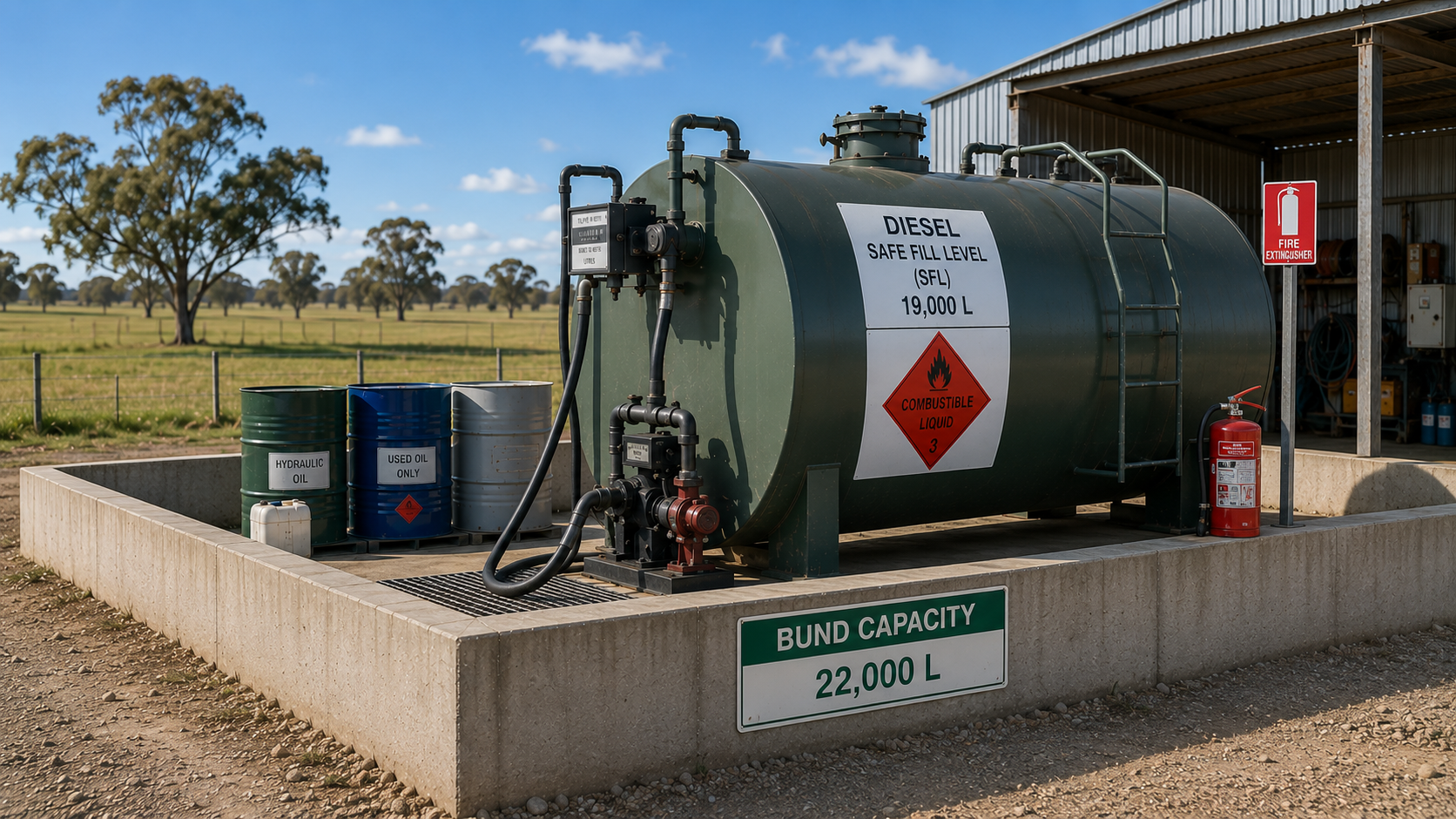
A lot of fuel and chemical storage setups on farms have been in place for years.
They look solid. They’ve never caused a problem. They’ve become part of the landscape of the business.
But familiar doesn’t always mean compliant.
When it comes to fuel and chemical storage, bunding plays an important role in spill containment and environmental protection. If a tank, container or storage system leaks, overflows or fails, the bund is expected to contain the spill and prevent fuel or chemicals escaping into soil, drains, waterways or surrounding areas.
The problem is that many existing farm setups were never formally designed or assessed as containment systems in the first place.
What a bund is actually expected to do
At its simplest, a bund has one job: contain a spill.
To do that properly, the setup needs to be suitable for what is being stored, large enough for the required volume and capable of stopping spills from escaping the containment area.
For above-ground tank storage, the relevant requirements may involve standards such as AS 1940:2017 for flammable and combustible liquids or AS 2507 for agricultural and veterinary chemicals, depending on the products being stored.
In practical terms, regulators and investigators are increasingly looking beyond whether a bund simply exists. The real question is whether it would actually perform if something went wrong.
Why earthen bunds can be high-risk
Earthen bunds are not automatically prohibited, but they can be harder to rely on with confidence unless they have been properly designed, assessed and maintained.
Many dirt bunds on farms have simply been shaped out of existing soil rather than engineered as containment systems. Over time, they can become porous, unstable, eroded or affected by weather and use.
To rely on an earthen bund, a business needs to be able to demonstrate that it can:
hold the required volume
prevent seepage into the ground
withstand the product being stored
allow spills to be safely recovered and removed
account for erosion, subsidence and weathering
Without that confidence, the setup should be reviewed before an incident occurs.
Common assumptions that can create risk
One of the biggest challenges with bunding on farms is that many businesses assume an existing setup must be acceptable simply because:
it has been there for years
it looks solid
nothing has gone wrong yet
other farms have similar setups
Unfortunately, those assumptions may not stand up if there is a spill, environmental issue, fire event or regulator investigation.
Questions worth asking now
If fuel or chemicals are stored on-farm, it is worth stepping back and asking:
What is being stored?
Is the bund suitable for that product?
Can it hold the required volume?
Is it in good condition and being maintained?
If something leaked tomorrow, would it actually contain the spill?
Could the product be safely recovered and removed?
If there is uncertainty around any of those questions, the safest approach is to have the setup reviewed before something goes wrong.
Download the practical factsheet
To help farmers better understand bunding requirements, spill containment risks and common issues with existing setups, we’ve prepared a practical factsheet:
Need a hand getting clarity?
If there’s uncertainty around your current bunding or fuel storage setup, the safest approach is to review it before something goes wrong.
Ingham & Co works with farmers to help make safety and compliance clearer, more practical and easier to manage.
👉 Book a free Safety Review (travel costs apply) and understand where you stand.
Ingham & Co – Making farm safety simpler, smarter and fit for the future.